
As of February 20, Bitdeer’s self-owned bitcoin holdings had officially fallen to zero.
Jihan Wu, the former “mining king” who once translated the Bitcoin white paper, spent four months converting all 2,233 BTC held at the peak into cash.
Even the newly mined coins from this week were all sold, setting off an uproar in the community.
Some called him a speculator. Others said he had stopped being a Bitcoin believer after the BCH fork.
But the truth is often harsher than faith.
Wu did not stop holding coins because he wanted to. He could no longer afford to.
A Long-Planned Exit
Bitdeer’s full liquidation was not a whim. It was a long-planned “strategic cash-out.”
A review of the selling timeline shows a clear rhythm: the first three quarters of 2025 were the “accumulation phase.” The strategy was to mine more and sell less, with holdings reaching an all-time high of 2,233 BTC in October 2025.
The fourth quarter of 2025 marked a “pause.” The strategy shifted to selling whatever was mined and stopping further accumulation, bringing holdings down to 2,017 BTC by the end of 2025. At the start of 2026, Bitdeer stepped on the gas.
Selling accelerated across the board: holdings fell to 1,530 BTC at the end of January 2026, dropped below 1,000 in mid-February, and hit zero on February 20.
In just four months, thousands of bitcoins were cleared out, bringing in a conservative estimate of $200 million — and likely more.
The speed and precision of the sales did not look like panic dumping. It looked like a planned cash-out and exit.
The reason Bitdeer had to monetize those holdings is buried in its financial statements.
The Real Pressure in the Financials
On February 12, Bitdeer released its results for Q4 2025 and the full year.
On the surface, full-year revenue reached $620 million, up 77%. The number looked strong, but it falls apart under scrutiny: the cost was a broad collapse in gross margin. Bitdeer’s full-year gross margin was cut from 19% to 9.8% in 2025, while Q4 gross margin was just 4.7%. Scale increased, but gross profit shrank.
As for net income, Bitdeer reported $65.6 million in full-year net profit for 2025, which appeared to mark a turnaround.
But a closer look shows that $445 million came from non-cash gains tied to changes in the fair value of convertible notes. That money cannot fund expansion, let alone dividends.
Stripping out that layer of financial window dressing, Bitdeer actually posted an adjusted full-year loss of $230 million.
That is because profits had already been swallowed by rising electricity prices in Norway, a fiercely competitive global network hashrate, and surging depreciation expenses from self-developed mining rigs — not to mention the continued decline in mining revenue.
More fatal than shrinking profits is the cash-flow hole.
Bitdeer’s net operating cash outflow reached $1.739 billion in 2025. Cash on the balance sheet evaporated by 69% in a year, leaving just $149 million.
Nearly $700 million at Bitdeer was poured into supply-chain prepayments and interest costs for self-developed mining rigs.
And Bitdeer is also taking on leverage at an extremely dangerous pace.
In 2025, its self-mining computing power surged nearly sixfold, while total liabilities approached $2 billion.
Revenue is rising, profits are shrinking, cash is disappearing, and debt is swelling.
In that financial condition, keeping thousands of BTC idle would not be a show of conviction. It would be irresponsible to shareholders.
A 3GW Gamble
Jihan Wu is not simply taking hits. He is making an even more capital-intensive bet: turning a mining company into an AI infrastructure company.
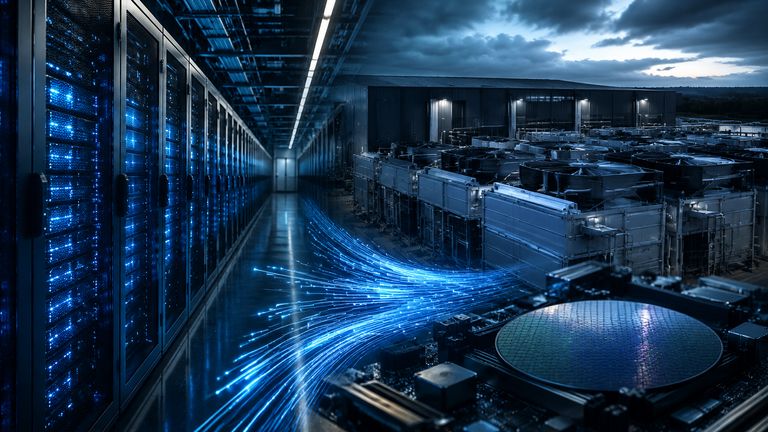
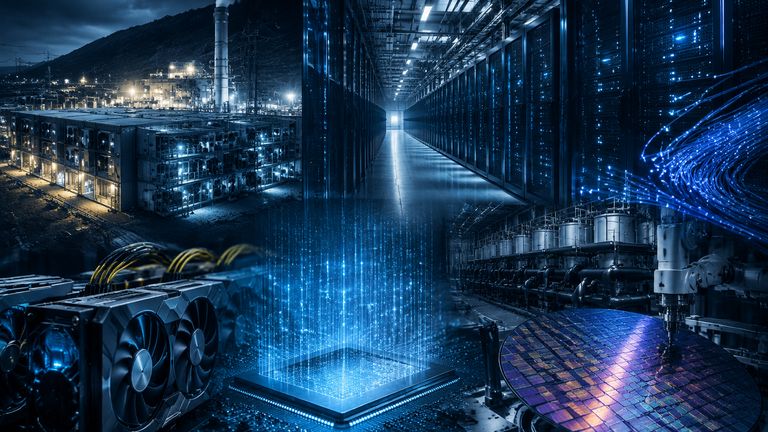
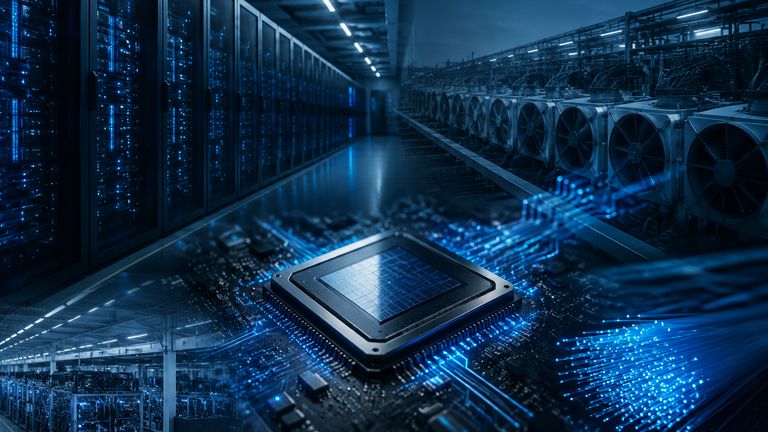
He has already started laying the groundwork. In the U.S. and Norway, he is converting power stations originally used for crypto mining into AI data centers.
Behind the heavy assets and high debt, what he is really accumulating at a frantic pace is not mining rigs, but as much as 3.0 GW of global power capacity. Of that, 1.66 GW is already operational. The 3.0 GW total equals the combined capacity of two leading North American mining companies and places Bitdeer firmly in the global top tier.
The logic makes sense. The company’s strategy also looks sound: large sites for AI hosting, smaller sites for GPU services.
But the reality is that the AI business is generating almost no revenue for now.
In the latest financial report, AI revenue accounted for only about 2% to 3% of total revenue, while roughly 65% still came from the old business of crypto mining. Full monetization of AI infrastructure will take until at least 2027.
During the gap before AI revenue materializes, the company has to stay alive.
Wu laid out the bottom line on the latest earnings call: “Self-mining is a highly defensive safety strategy that ensures we can still be profitable in an extremely cold market. This will be crucial in 2026.” In other words, in Wu’s view, mining has moved back to the defensive line.
For Bitdeer, bitcoin is no longer a faith asset to be held at all costs. It has become “fuel” for powering its AI future.
The market’s view of Bitdeer is splitting sharply.
Its share price has fallen 18.8% over the past month, while Wall Street institutions are taking opposite sides: Bank of America and Lazard have sharply cut or exited positions, while Fidelity and Barclays have been aggressively building stakes.
The focus of this high-stakes selloff is simple: how much are Bitdeer’s 3.0 GW of power assets worth in the AI era?
To survive this AI gamble, Jihan Wu chose to liquidate Bitdeer’s bitcoin.
Years ago, he blasted his partner Micree Zhan’s push into AI as “loving vanity rather than technology,” a dispute that helped drive the two men apart.
Now, after six years, he has become the very thing he once hated — using the cash flow from mining to fill the hole left by AI.
Jihan Wu responded on February 22, 2026: “Holding zero now does not mean it will always be this way in the future.”
The hard reality is that Wu’s bitcoin liquidation has nothing to do with faith. It is about survival.
Whether this gamble can pay off will not be decided by the bitcoin price, but by how many AI hosting contracts he can sign in 2026.



Comments
00No comments yet. Be the first to weigh in.