
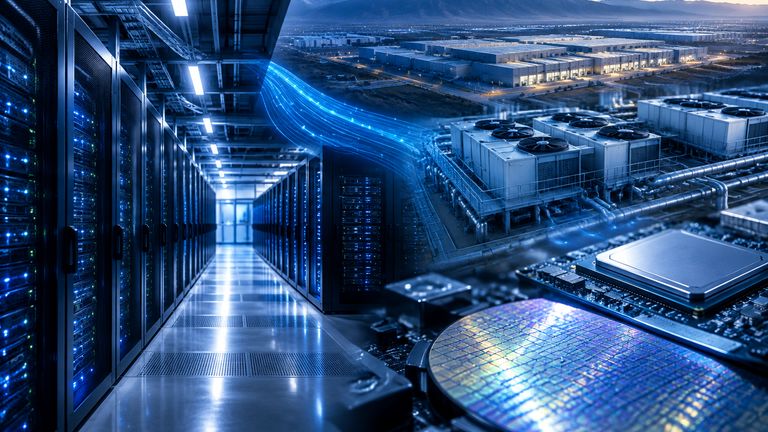
AI data center infrastructure is being built at ever larger scales. Projects in cities such as Zhongwei in Ningxia and Ulanqab in Inner Mongolia are either part of the eight national computing power hub nodes under China’s East Data West Computing project, or single projects within the country’s 10 major data center clusters that have reached GW (gigawatt) scale. Investments often run into tens of billions of yuan, with several projects under construction at the same time. On August 6, Envision Technology Group, or Envision, said it had completed the world’s largest standalone AI (artificial intelligence) computing power facility in Ulanqab, with planned capacity of more than 2 GW.
The 21Vianet Ulanqab data center, currently China’s second-largest by capacity, has about 221 MW (megawatts) of IT power and is also expected to expand to GW scale. According to research firm EpochAI, the world’s largest Colossus 2 data center has reached 946 MW of IT power. China’s largest facility, Huawei’s Horinger data center in Hohhot, has about 242 MW of IT power.
Using Colossus 2 as a reference, a data center with 1 GW of IT power would require roughly $35.8 billion in capital investment and provide computing power equivalent to 1.112 million H100 GPUs. A person in charge at a leading data center infrastructure company told reporters that computing power demand has now clearly split into tiers: at one end are ten-thousand-GPU-scale large-model training workloads for national-level users and top internet companies; at the other are the hundreds-of-petaflops fine-tuning and inference needs of local governments and industry customers.
GW-scale campuses are creating new challenges for data center infrastructure construction. Previously, AI data centers were typically built at the tens-of-MW level, while a 100 MW AI data center was considered an ultra-large project. Building a GW-scale AI data center is not just an expansion of investment by dozens of times; it is also a test of the limits of infrastructure. AI data center infrastructure is becoming tiered. A person responsible for investment promotion in a county-level city in South China told reporters that the prefecture-level city government where he works requires every county to bring in an AI data center.
He ultimately brought in an AI data center project from a listed company in the province, with total investment of several hundred million yuan, converting an existing factory building in an industrial park into an AI data center. Because the county has no internet companies, and provincial AI data center demand has already been centrally planned for another prefecture-level city, there is limited external computing power demand it can absorb. As a result, he did not seek to attract an overly large AI data center. Reporters learned that leading domestic AI data center infrastructure companies are interested in working with local governments to set up small AI data centers in cities across China by incubating sub-brands.
“Leading companies are still focused mainly on large, GW-scale data centers, though they may build small AI data centers in some cities depending on local policies. Small AI data centers will mainly serve local daily computing power demand in the future, such as local residents using AI, where it would be best to call on local computing power,” the head of a leading AI data center infrastructure company told reporters. Large-scale AI data center construction is concentrated mainly in cities such as Zhongwei in Ningxia and Ulanqab in Inner Mongolia.
According to relevant data, as of June 2025, Ulanqab in Inner Mongolia had signed computing power industry projects with total investment of more than 250 billion yuan. Five projects, including those from Alibaba, CICC and 21Vianet, each exceed 10 billion yuan in investment; eight projects, including those from Kuaishou and Yueke, each exceed 5 billion yuan; and 48 projects, including those from Huawei and Apple, each exceed 1 billion yuan. In March this year, GDS signed an agreement with Ulanqab to invest 30 billion yuan over the next five years to build data centers;
21Vianet’s projects under construction in Ulanqab involve total investment of more than 6 billion yuan; Envision Energy is building an AI data center in Ulanqab covering about 600 mu, with capacity at GW scale. The main lever these cities use to attract large-scale data centers is power. Power includes grid access capacity, renewable energy site selection and municipal electricity prices. The head of the leading AI data center infrastructure company mentioned above told reporters that these cities generally offer AI data centers preferential power rates below standard municipal electricity prices.
Because AI data centers are now required to use a high share of green power, renewable energy site resources and green power resources are also being tilted toward AI data centers. Reporters learned that starting at the end of 2025, top internet companies have been intensively launching GW-scale AI data center projects. “Three years ago, bids from top internet companies were all at the 100 MW level. Last year, top internet companies were the first to tender GW-scale campuses, and other companies quickly followed. Competition among leading vendors for computing power infrastructure is extremely intense.
” said Li Jun, deputy general manager of Envision’s artificial intelligence computing power center product line. Reporters learned that as AI shifts from training to inference, the scale of inference-side data has jumped from the tens of thousands of hours to the millions of hours. User deployment models have fully shifted from “self-owned computing power plus privately deployed open-source models” to calling tokens. As embodied intelligence and world models are implemented in the future, demand for APIs (application programming interfaces) and tokens will continue to expand.
Token usage by China’s major internet companies is surging. For example, as of June 2026, the Doubao large model averaged 180 trillion token calls per day, more than 1,500 times higher than at launch and more than 10 times higher than a year earlier. GW-scale AI data centers can significantly reduce computing power costs. A person at a leading AI data center infrastructure company told reporters that GW-scale campuses can effectively spread land and construction costs, and, as major projects, can also secure preferential local government policies on land and electricity prices.
The larger the AI data center, the lower the computing power price. A 21Vianet representative said that to build a GW-scale AI data center, the local area first needs a strong and reliable grid structure. Second, a campus consumes tens of thousands of tons of water each year, making water-scarce regions difficult hosts. Finally, because campuses use diesel generation as backup power, they must sign high-priority fuel supply agreements with nearby fuel suppliers.
For power access, the common practice for data centers is to secure supply through two municipal power feeds. In western China, however, multiple measures should be adopted to effectively meet the national requirement that newly built and expanded data centers at hub nodes consume no less than 80% green power. Taking 21Vianet’s Ulanqab project as an example, it relies on local wind and solar resources to build a direct supply system combining wind and solar power, a green dedicated line and energy storage. Once completed, the project will receive 50% of its power through direct green power supply, and can achieve 100% green power supply for the data center when combined with green power trading and green certificates.
“A 400 MW data center is not two 200 MW data centers bolted together; the construction difficulty grows exponentially,” the head of the leading data center infrastructure company said. For example, a power distribution architecture suitable for 200 MW struggles to meet 400 MW requirements, heat dissipation in ultra-large standalone buildings is extremely difficult, and as density rises, network latency issues become more pronounced.
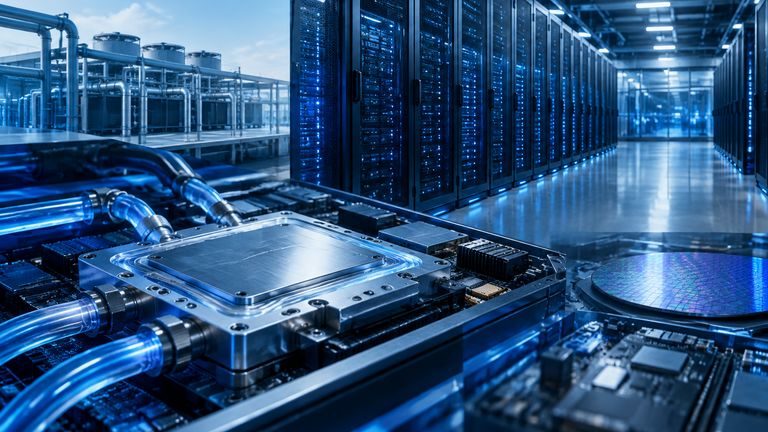
The floor heights of GW-scale data centers also need to be replanned. The head of the leading AI data center infrastructure company said liquid cooling is essential in GW-scale AI data centers. At 40 kW (kilowatts) per cabinet, floor heights are designed to exceed 6 meters to solve air-liquid compatibility issues. If power per cabinet rises further, floor heights will need to increase again. “Because they are so difficult to invest in and build, GW-scale campuses have already become ‘strategic resources’ in the eyes of top customers.
” Li Jun said. For example, while some projects are still at the approval stage, hundreds of MW of capacity in Envision’s GW-scale campus have already been locked in by top customers. Industry concentration will rise. “As AI data centers move toward GW scale, this is no longer the era when projects could be built simply with approvals and policy support. The trend is toward large scale, specialization and clustering,” Li Jun said. Large scale means more money. Upfront investment in a GW-scale AI data center exceeds 20 billion yuan, a burden not only beyond small and midsize companies but also difficult for leading companies.
AI data center infrastructure is a heavy-asset business. Reporters learned that payback periods for domestic AI data center infrastructure vary widely depending on rack occupancy rates, electricity costs and other factors. Civil construction and electrical-mechanical systems are depreciated over 20 years, while GPUs (graphics processing units) are depreciated over five years. The payback period is generally around eight years. Customers typically do not cover AI data center infrastructure costs, leaving AI data center infrastructure companies to find funding on their own.
A veteran in the public REITs (real estate investment trusts) industry told reporters: “Recently, I have been in contact with a number of data center infrastructure companies. My overall impression is that market-oriented private data center infrastructure companies are facing a serious shortage of funds. Central and local state-owned enterprises that can access ‘cheap money’ or special funds, with funding costs of around 2%, have an advantage.” He said many market-oriented private data center infrastructure companies want to issue public REITs or private REITs to recover capital, but successful issuance depends on the data center having already signed contracts with major customers and having sustained, stable cash flow. Data center infrastructure without long-term contracts has difficulty raising funds.
According to him, many data center companies are considering packaging data centers, renewable energy power stations and other assets for listing through public REITs to recover capital for reinvestment. The person at the leading AI data center infrastructure company mentioned above told reporters that GW-scale AI data centers have completely changed the project development process. He gave the example of traditional MW-scale AI data centers, which are usually designed and delivered in one go, then leased to customers for rent.
Because GW-scale AI data centers require such large investment and long construction cycles, companies can only first secure land and power, then build in phases, with each phase at about 100 MW to 200 MW. Some even have to acquire land in stages and place orders based on customer demand. Specialization means top customers have extremely high requirements for AI data centers. “When top customers sign GW-scale campus contracts, infrastructure alone requires investment at the tens-of-billions-of-yuan level, and including cabinets pushes the investment above 100 billion yuan.
Every top customer has very rigorous technical requirements and standards,” Li Jun said. The person at the leading AI data center infrastructure company cited an example: top internet customers have extremely high risk-control thresholds and prioritize leading operators with strong industry recognition, years of experience and listed-company backing. Hard requirements include at least five years of operating history, self-owned data center property, and at least three comparable leading customer cases, with China’s Level 3 cybersecurity protection certification and data center security certifications used as entry qualifications.
Clustering means energy consumption quotas, green power resources and computing power demand are becoming increasingly concentrated, leaving limited resources available for small-scale computing power centers. Li Jun said top customers naturally prefer computing power business clusters because they make interconnection easier. Training workloads favor nodes with strong expansion capacity and low operating costs, giving GW-scale campuses a major advantage. Inference workloads need to be as close to users as possible, so distributed small-scale computing power centers may still have demand;
Integrated training-and-inference workloads place emphasis on nodes. Once a single node is saturated, customers look for the next node, while GW-scale campuses can basically cover the demand of a single node. “GW-scale campuses are expected to form a snowballing positive cycle in which larger scale brings lower costs, more orders and further expansion. As the market shakes out, the room for small and midsize companies will narrow, leaving three paths: mergers and consolidation, retreat into niche scenarios such as edge computing, or shutdown and exit.
” the head of the leading data center infrastructure company said.
Comments
00No comments yet. Be the first to weigh in.