
Large models can now hold fluent conversations and recognize objects in images, but a more fundamental question remains unresolved: do they actually “understand” the three-dimensional world we live in?
How far away something is, which object is larger, which way to turn when moving from A to B, and whether sequences remain consistent across multiple viewpoints: judgments that feel almost instinctive to humans are precisely the capabilities needed for embodied AI, autonomous driving, robot navigation, and AR/VR.
The industry is gradually converging on a view: the next phase of competition will not be only about language and semantics, but also spatial intelligence.
To make that capability real, Huawei’s GTS AI Algorithm Department, together with The Chinese University of Hong Kong, Shenzhen and The University of Hong Kong, has released its latest work, SpaceMind:
using only RGB input, without relying on depth maps or point clouds, it pushes the spatial reasoning ability of pure vision-language models close to human levels.
On VSI-Bench, the authoritative spatial intelligence leaderboard created by Fei-Fei Li’s team, SpaceMind set a new record with an overall score of 70.6%, while the human average is only around 79%.
The work has been accepted by CVPR 2026.
Why the Camera Cannot Be Treated as a Footnote
The paper states clearly that existing VLMs often treat camera parameters, including intrinsics and extrinsics, as ordinary metadata when handling spatial tasks, simply concatenating them with geometric features. This blurs “viewpoint” and “scene,” making it hard to build a consistent spatial representation: the model may have “seen” something without knowing “where it saw it from.”
Human spatial understanding is never just about “what was seen,” but “from which position it was seen.” This coupling of observation and viewpoint supports how people estimate distance, compare size, infer connectivity, and plan routes in unfamiliar environments. The “spatial intelligence-driven AGI” advocated by Professor Fei-Fei Li is built on this cognitive foundation.
SpaceMind’s core insight is to write that mechanism into the model architecture: the camera becomes the “conductor” of fusion, rather than a passive appendix.
Measuring whether a model has this capability requires an authoritative, comprehensive benchmark that reflects human cognition. VSI-Bench, created by Fei-Fei Li, quickly became a recognized touchstone for spatial intelligence: humans average about 79% accuracy, while the strongest prior open and closed systems had long hovered around 60% overall, still a clear distance from “truly understanding the 3D world.”
SpaceMind: A Camera-Guided Three-Modality Fusion Paradigm
1. For the first time, camera representation is defined as a “guiding modality.” Instead of treating the camera as an ordinary feature on the same level as the scene, SpaceMind uses it as an active modulation signal that guides how spatial information is injected into the visual-semantic stream, bringing the model closer to human egocentric spatial cognition.
2. It is plug-and-play and does not alter the VLM backbone. The approach does not require changes to the core structure of the visual encoder, language model, or connector. It inserts a lightweight Camera-Guided Modality Fusion module, or CGMF, before inputs enter the LLM, allowing seamless integration with mainstream architectures such as InternVL and Qwen-VL while sharply reducing the cost of pretraining from scratch and migration.
3. It enables metric-level spatial reasoning from pure RGB. A single image or short video can support difficult tasks including absolute and relative distance estimation, object sizing, room-scale reasoning, route planning, and cross-view appearance ordering, reducing dependence on depth sensors, point clouds, or multi-view reconstruction pipelines and moving closer to real deployment settings.
Architecturally, SpaceMind uses a dual-encoder design: InternViT provides semantic visual tokens, while VGGT provides geometry-aware spatial tokens and per-frame camera tokens. During fusion, CGMF applies camera-conditioned bias to spatial tokens, learns query-independent geometric importance weights, and gates the fused result with camera embeddings. This aligns “viewpoint, geometry, and semantics” within a unified framework while maintaining compatibility with standard VLM interfaces and supporting end-to-end RGB-only training.
Experimental Results: Broad Gains, Not Just One Score
On VSI-Bench, SpaceMind achieved 70.6% overall accuracy, significantly outperforming geometry-enhanced baselines such as Spatial-MLLM and VLM-3R, and opening gaps across multiple subtasks.
For example, on appearance order, a highly challenging cross-view consistency task, it improved by as much as 30.5 percentage points over previous methods. That suggests explicitly modulating spatial tokens with camera signals helps integrate cross-view evidence and stabilize ordering judgments across viewpoints. Route planning also remained highly competitive.
On SQA3D, a benchmark for contextualized 3D question answering based on real indoor reconstructions, SpaceMind delivered the best performance on most question types. It did so using only video RGB input, without relying on auxiliary modalities such as depth, point clouds, or meshes, showing that camera-guided fusion can recover strong 3D spatial cues from ordinary video.
In SPBench’s out-of-domain generalization evaluation, where the training data did not include the benchmark, SpaceMind scored 67.3% overall, far ahead of general closed models such as GPT-4o and Gemini-2.0-Flash, as well as open-source and specialized spatial models such as Qwen2.5-VL and Spatial-MLLM. Even on the single-frame subset, under a setting trained only on 32-frame video clips, it still showed strong cross-scene transfer, which is especially important for “single-image question answering” in real products.
Ablation experiments further validate the design logic: on the InternVL3-8B baseline, shallow cross-attention fusion of VGGT spatial tokens alone brings a gain of 3.7 points. Adding the token-weight MLP and geometric MLP then delivers continued and stable improvements on numerical and multiple-choice subtasks, with the full SpaceMind architecture reaching the highest average accuracy.
This is not about piling on modules. It turns the long-standing 3D vision principle of separating the roles of camera and scene into a trainable, scalable inductive bias.
SpaceMind++: From Single-Frame Spatial Reasoning to Video-Level “Cognitive Maps”
For the dynamic real world, the team further drew inspiration from the mammalian two-stream visual system and proposed SpaceMind++, a video MLLM architecture that can explicitly build voxelized cognitive maps from RGB video.
Through a coordinate-guided deep fusion mechanism, it reorganizes fragmented viewpoints into a unified 3D metric representation, pursuing spatial consistency and object permanence reasoning in dynamic scenes. The goal is for the model not just to “answer one frame correctly,” but to “remember this room, this object, and this route.”
The code will be open-sourced soon.
Scaling Up on Ascend 384-Card Nodes: Pushing Spatial Intelligence to Larger Scale
If the paper and benchmark results show that the SpaceMind direction is correct and effective, engineering-side scaling is pushing that direction toward an industry-usable scale.
The team is now carrying out large-scale pretraining and post-training of the SpaceMind spatial intelligence model series on Huawei Ascend NPU clusters. Using a 384-card Ascend 910C computing power pool, it is scaling model size, long-video context, and multitask data in parallel, moving camera-guided fusion from leaderboard validation toward an iterative, deployable engineering foundation and continuing to raise SpaceMind’s ceiling for spatial reasoning.
Toward Industry Deployment: Supporting AIDC Survey and Design
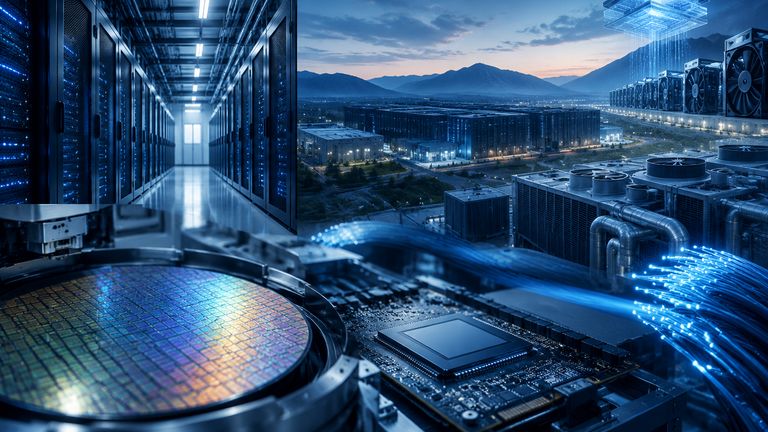
The value of spatial intelligence ultimately has to land in real-world scenarios. The SpaceMind technology series will be applied to key stages such as survey and design across the full lifecycle of AIDC, or AI data centers:
With distance estimation, scale comparison, and spatial relationship reasoning from pure RGB input, the model can help interpret aerial images of campuses, on-site inspection videos, and real images of equipment rooms. It can understand building layouts, equipment placement, and corridor relationships, providing explainable spatial judgment for site selection comparisons, floor planning, cabinet row arrangement, and cabling design.
With SpaceMind++’s video-level cognitive mapping capability, it can also integrate multi-view and multi-period site records into a consistent 3D spatial understanding, reducing repeated site visits and manual measurement costs while improving efficiency and decision quality in the survey and design stage.



Comments
00No comments yet. Be the first to weigh in.