
On October 28, Huawei's China Tour 2026 Hubei Provincial AI Innovation and Development Conference was held in Wuhan under the theme "Digital Intelligence for Jingchu, Rising to the Occasion." At the event, the thousand-card Ascend 950 super-node AI computing cluster funded by Hubei Science and Technology Investment Group was officially switched on. A day later, on October 29, China's first 1,024-card Ascend 950DT AI computing cluster formally entered service in Wuhan.
Those two statements describe two milestones in the same project: the switch-on on the 28th, and the start of operations on the 29th.
Turning 1,024 Cards Into a Single Machine
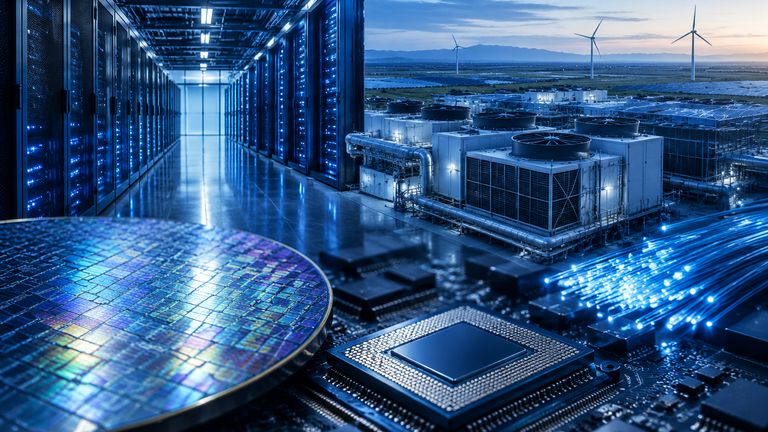
The system's form factor is called the 1,024-card Ascend 950DT liquid-cooled super-node, with 1,024 Ascend NPU accelerator cards integrated into a single node.
A super-node means linking hundreds or thousands of accelerator cards with high-speed interconnects into what is logically one large machine, so they work together as if inside a single chip. The hard part is entirely in the interconnect: if cards still have to route through switches and take multiple hops to reach each other, bandwidth and latency get eaten up, and the efficiency of model-parallel training drops with them.
This cluster uses the UnifiedBus architecture, which lets every accelerator card in the cluster address every other directly, with no relays and no routing. Card-to-card interconnect bandwidth reaches the terabyte level, and end-to-end communication latency holds steady in the microsecond range.
How 1 EFLOPS and 256TB Fit Together
The full cluster delivers 1 EFLOPS of FP8 computing power, paired with 256TB of global unified memory.
An EFLOPS is a quintillion floating-point operations per second. FP8 is an 8-bit floating-point format: fewer bits, higher throughput, and a commonly used precision tier in large-model training and inference. Read together, the figures mean this 1 EFLOPS is measured at low precision.
"Global unified memory" deserves its own note. Conventionally, each card manages its own slice of video memory; when a model does not fit, it gets split across multiple cards that then fetch data from one another. Global unified memory instead organizes the memory of all 1,024 cards into a single 256TB address space. The model sees one large memory pool and no longer has to be partitioned card by card.
The configuration targets two kinds of workloads: training trillion-parameter models, and real-time inference for complex agents. The first is hungry for computing power and interconnect bandwidth; the second is hungry for low latency, since inference generates output step by step and any single hop's delay gets amplified across the entire run.
This Time, Liquid Cooling Covers the Interconnect Cabinets Too
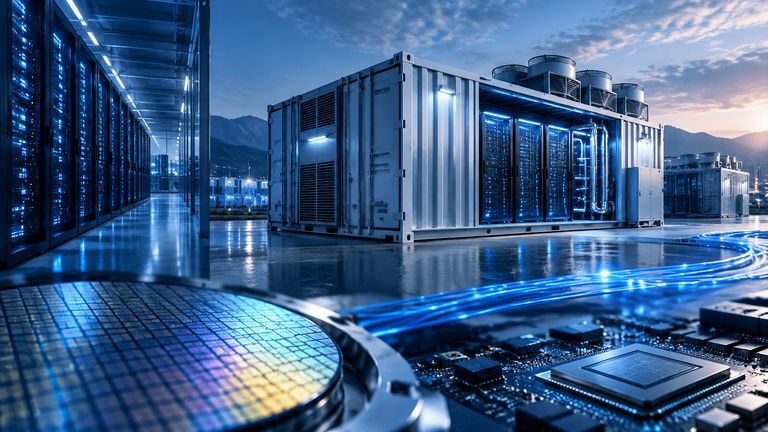
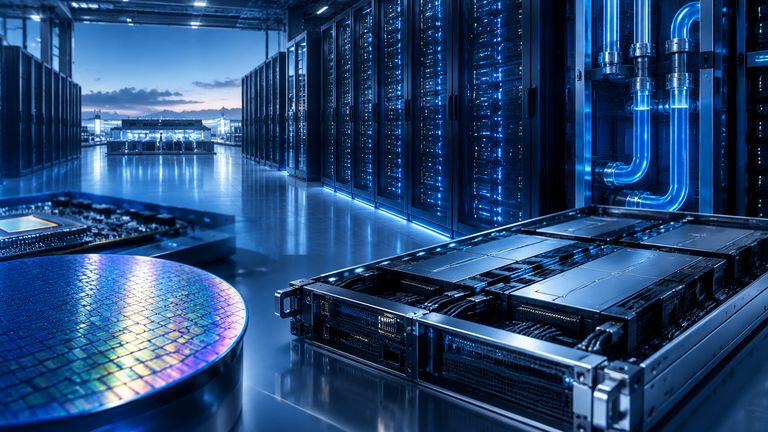
The thermal design is the most revealing part of this cluster: integrated liquid cooling across both compute cabinets and interconnect cabinets.
As AI computing density keeps climbing, traditional air cooling is struggling to handle the heat loads of high-density computing. That has pushed liquid cooling from an optional add-on to a baseline infrastructure capability for high-density computing systems, and this design puts that judgment into concrete practice.
More telling is that the interconnect cabinets have been brought into the liquid-cooling loop. Liquid cooling used to serve mainly the hottest compute units, leaving interconnect gear to air cooling. Bringing interconnect cabinets into the same system signals that high-bandwidth interconnect equipment now carries engineering demands around thermal management, operational reliability, and day-to-day maintenance on par with the core compute units.
Put another way, this cluster does not just submerge the compute cards in coolant. It treats the entire data path as a heat source.
One Month to Switch-On, and Who It Serves
Hubei Science and Technology Investment Group says the cluster went from project kickoff to switch-on in just one month.
Its purpose is spelled out in detail: serving key research institutions and industrial players within Hubei province, and directly supporting large-model training plus the development, tuning, and large-scale deployment of industry-specific AI agents. The problem it is meant to solve is the local squeeze on high-end computing supply, the everyday reality of companies queuing for compute resources while R&D timelines slip.
That may be the more noteworthy detail, beyond the "first in China" label: a thousand-card domestic computing cluster compressed from kickoff to switch-on in a single month. Whether the chips work is one question. Whether they can be turned quickly into compute that local users can actually line up for is another.
Comments
00No comments yet. Be the first to weigh in.